Outdoor String Lights Ideas: 15 Ways to Brighten Your Patio, Deck, and Garden
Outdoor string lights ideas tend to split people into two camps: the homeowner who runs a single line along a fence and calls it done, and the one who wants the whole yard glowing like an evening market. This guide lands somewhere more useful — 15 concrete setups you can install in an afternoon, with the bulb type, length, and mounting hardware spelled out so you don’t buy the wrong thing twice.
String lights remain the fastest way to change how a backyard feels after dark, and the numbers make the case. A full cafe-light canopy over a 20-by-20-foot patio runs $80 to $250 in materials and needs no electrician, whereas the professional landscape lighting systems that light trees, paths, and facades typically run $3,000 to $6,500. String lights are ambient; landscape lighting is architectural. A well-lit property usually uses both, playing them off each other.
The catch is that string lights are only as good as their planning. Buy weather-resistant bulbs instead of indoor lights, size the run correctly, and hang them so wind and kids can’t knock them down, and they’ll last for years. Skip those steps and you’ll be replacing a sagging, half-dark mess by summer’s end.
Why String Lights Are the Easiest Outdoor Upgrade
No other exterior project changes a space this fast for this little money. A quality 25-foot strand of commercial-grade LEDs from a brand like Enbrighten or Brightown runs $35 to $70, and installation is a drill, a few screw hooks, and an hour on a Saturday. Compare that with a deck stain, a new fence, or even a modest path lighting install, and string lights win on effort for dollar every time.
They also scale. One strand over a bistro table reads intimate; a dozen crisscrossed over a paver patio reads like a restaurant terrace. Because the bulbs are the aesthetic, you get dimmable, color-temperature, and even color-changing options, and you can move the whole thing to a new spot next season without re-trenching wire.
15 Outdoor String Lights Ideas for Every Space
The best use for string lights depends on where you hang them. Here are the setups that look intentional rather than thrown together.
- Cafe-light canopy over a patio. Crisscross two layers of globe string lights 8 to 10 feet high. This is the single most-pinned backyard look and works on any flat seating area.
- Perimeter glow along a fence line. Run one strand at 6 to 7 feet along the top rail. Use all-weather sockets and stake the slack between posts.
- Deck rail and stair accent. Wrap a low-profile strand under the top rail so bulbs face outward. Good for safety as well as mood.
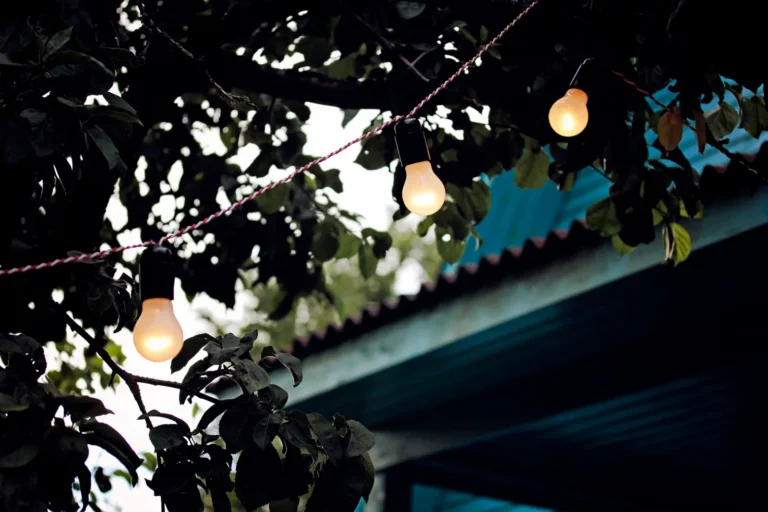
- Tree-trunk spiral. Wind a strand up a mature trunk from 3 feet to 8 feet. In the fall and winter it turns a bare tree into a focal point.
- Umbrella and pergola drape. Loop lights around a cantilever umbrella’s ribs or drape them along pergola beams for shade-plus-glow.
- Fire-pit ring. Hang lights in a lazy loop 9 feet up around the seating circle so no one sits in shadow.
- Privacy-wall backdrop. Run vertical strands down a trellis or lattice to wash a blank wall with light.
- Pool and waterline twinkle. Keep the bulbs several feet back from the water’s edge and use only fixtures rated for damp or wet locations.
- Garden path guide. Pair short string-light runs with solar path lights along a walkway to mark the edges after dark.
- Outdoor dining chandelier. Bundle three strands and hang them over a long table from a single overhead anchor point.
- Porch and entry frame. Outline the top of a covered porch for curb appeal that greets visitors.
- Shed or workshop overhang. Light a workspace under an eave with shatterproof, wet-rated bulbs.
- Garden arch and gate. Highlight an arbor with a double pass so you walk through the light, not past it.
- Seasonal tent and event tent. Suspend lights from a pop-up canopy frame using zip ties rated for the strand’s weight.
- Backyard movie-night wall. Backlight a projector screen with a single dim strand set to 10% so the screen stays visible.
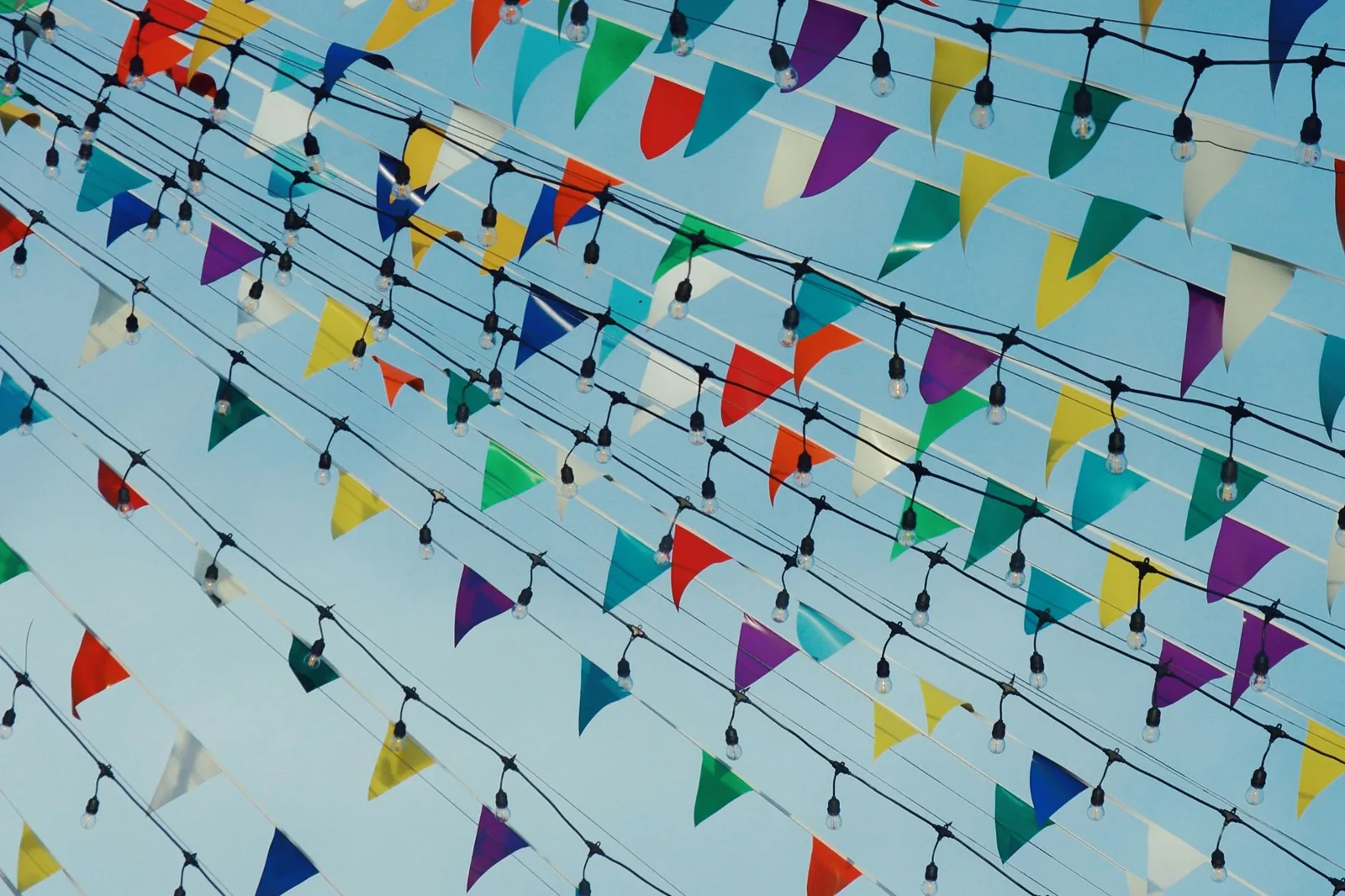
Photo by Orkhan Sweden via Pexels
Cafe Lights vs. Globe Lights: Which Bulb Should You Buy?
The bulb shape sets the whole tone, and the two you’ll see most are cafe lights (also called bistro, Edison, or festoon) and globe lights. Here’s how they compare before you commit.
| Feature | Cafe / Edison Lights | Globe Lights |
|---|---|---|
| Bulb look | Exposed-filament teardrop, vintage amber | Round frosted globe, softer diffused glow |
| Best for | Dining, fire pits, rustic and boho yards | Modern patios, canopies, larger commercial feel |
| Typical wattage | 0.5W–1W per bulb (LED) | 1W–2W per bulb (LED) |
| Color temperature | 2000K–2700K warm | 2700K–3000K neutral-warm |
| Price per 25 ft | $35–$70 | $40–$90 |
| Durability | Filament bulbs more fragile; look for shatterproof | Plastic globes survive wind and impact better |
For most backyards, a 2700K warmth is the sweet spot — bright enough to read a menu, warm enough not to feel clinical. If you plan to leave lights up year-round, pay the small premium for shatterproof plastic or acrylic globes over glass, because a single hailstorm or a wayward ladder will tell you exactly which brand was cheaper.
How Many Feet of Lights Do You Need?
The most common regret is buying too little. The gap-to-gap rule for classic cafe lights is 1 bulb per 2 feet of wire, so a 25-foot strand gives you roughly 12 to 13 bulbs and covers about 20 linear feet of hanging space once you account for slack.
For a canopy, calculate the total length by measuring the perimeter of the area plus the diagonal cross-strings, then multiply by 1.3 to leave room for the gentle droop that makes the look work. A 12-by-12-foot patio canopy typically needs 100 to 130 feet of lights, which means four to six strands linked together. Always check the strand’s maximum connectable run — most commercial sets allow 3 to 5 strands daisy-chained, and pushing past that dims the far end or trips a breaker.
Power Options: Plug-In, Solar, or Battery?
Where your power comes from decides how freely you can hang the lights. The three routes break down like this.
| Feature | Plug-In (120V) | Solar | Battery |
|---|---|---|---|
| Up-front cost | Lowest per foot | Mid, $20–$50 per strand | Lowest overall, $15–$30 |
| Brightness | Brightest, runs all night | Dimmer, 4–8 hours on a full charge | Dim, 10–20 hours on AA/C batteries |
| Install effort | Needs an outdoor GFCI outlet | None, but panel needs direct sun | None, swap batteries seasonally |
| Best for | Permanent patios and canopies | Fences, arbors far from outlets | Sheds, tents, short-term events |
For permanent string lights you’ll actually use, plug-in wins almost every time. If you’re lighting a spot with no outlet nearby, our solar lights vs. low-voltage comparison explains when solar is worth it, and the low-voltage lighting cost guide covers what a slightly more involved hardwired setup runs. Reserve battery strands for one-off events, since feeding them fresh batteries a few times a summer erases any up-front savings.
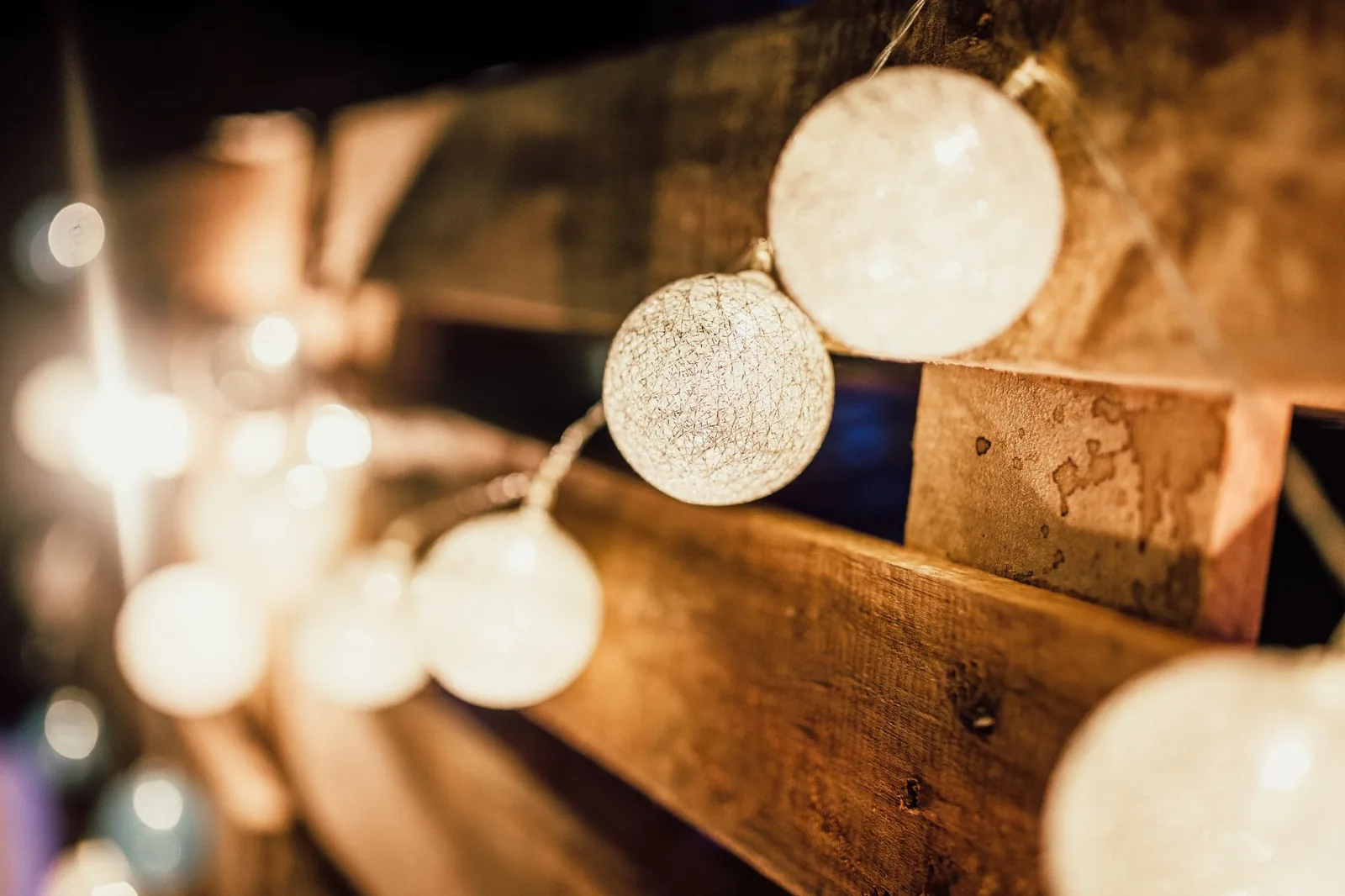
Photo by Juan Pablo Serrano via Pexels
Hanging String Lights Without Damaging Your Home
The wrong hardware turns a two-hour job into a repair bill. Skip the nails and thumbtacks; use these mounts instead.
- Screw hooks and cup hooks into wood beams or fascia. Pre-drill a pilot hole to avoid splitting, and choose hooks rated for at least double the weight of the run.
- Vinyl-siding hooks that clip into the seam without drilling, for rentals and vinyl exteriors.
- Tension-wire or guide-wire kits. Run a steel cable first, then zip-tie the strand to it so the sockets — not the internal wire — bear the weight. This is mandatory for any span over about 20 feet.
- Adhesive brick clips for masonry walls, though in freeze-thaw climates a drilled masonry anchor is the one that stays up.
- Tree-friendly straps rather than nails, so bark heals and the tree grows without girdling.
Keep lights 8 to 10 feet above walkways and seating so no one clips a bulb, and leave a little slack so wind moves the strand rather than snapping it. Space supports every 10 to 15 feet for straight runs and closer on curves. If you’re pairing the look with a broader redesign, most of these ideas line up with the setups in our backyard landscape lighting ideas guide.
Frequently Asked Questions
Are outdoor string lights safe to leave up year-round?
Yes, if the set is rated for outdoor/wet locations and the sockets are sealed. Look for an IP65 rating or higher and shatterproof bulbs. Bring battery and cheap indoor-style strands in before the first frost.
How many string lights can I connect together?
Most commercial strands allow 3 to 5 strands connected end to end, but check the “maximum run length” printed on the box or product page. Exceeding it dims the final strand and can trip a circuit, especially with incandescent bulbs.
Do outdoor string lights use a lot of electricity?
No. A 50-foot LED strand draws roughly 15 to 25 watts, so running one eight hours a night adds about $1 to $2 per month to the bill, per the U.S. Department of Energy. Incandescent versions can draw five times that.
What’s the difference between damp-rated and wet-rated lights?
Damp-rated handles humidity and light moisture under a covered porch. Wet-rated handles direct rain, snow, and hose spray. Buy wet-rated for anything fully exposed, like a fence line or tree spiral.
Can I hang string lights without drilling holes?
Yes. Vinyl-siding clips, adhesive brick clips, tension-wire kits anchored to posts, and tree straps all hold lights without a drill. For a permanent patio, a few proper screw hooks beat every no-hole trick for staying power.
The Bottom Line
String lights are the rare outdoor upgrade that pays for itself on the first night you flip them on. Start with the biggest decision — plug-in cafe lights for a permanent patio, or solar for a far fence line — then buy a little more length than you think you need, mount to proper hardware rated for the weight, and keep everything at 2700K for a warm, usable glow.
Get the ambient layer right first, then let the harder jobs come later. For professional-grade washes and path safety, This Old House has a thorough primer on permanent landscape lighting, and our landscape lighting cost guide shows what the full architectural treatment runs. Until then, one weekend and a couple hundred dollars is all it takes to turn a dark patch of grass into the best room in the house.